Student Work I


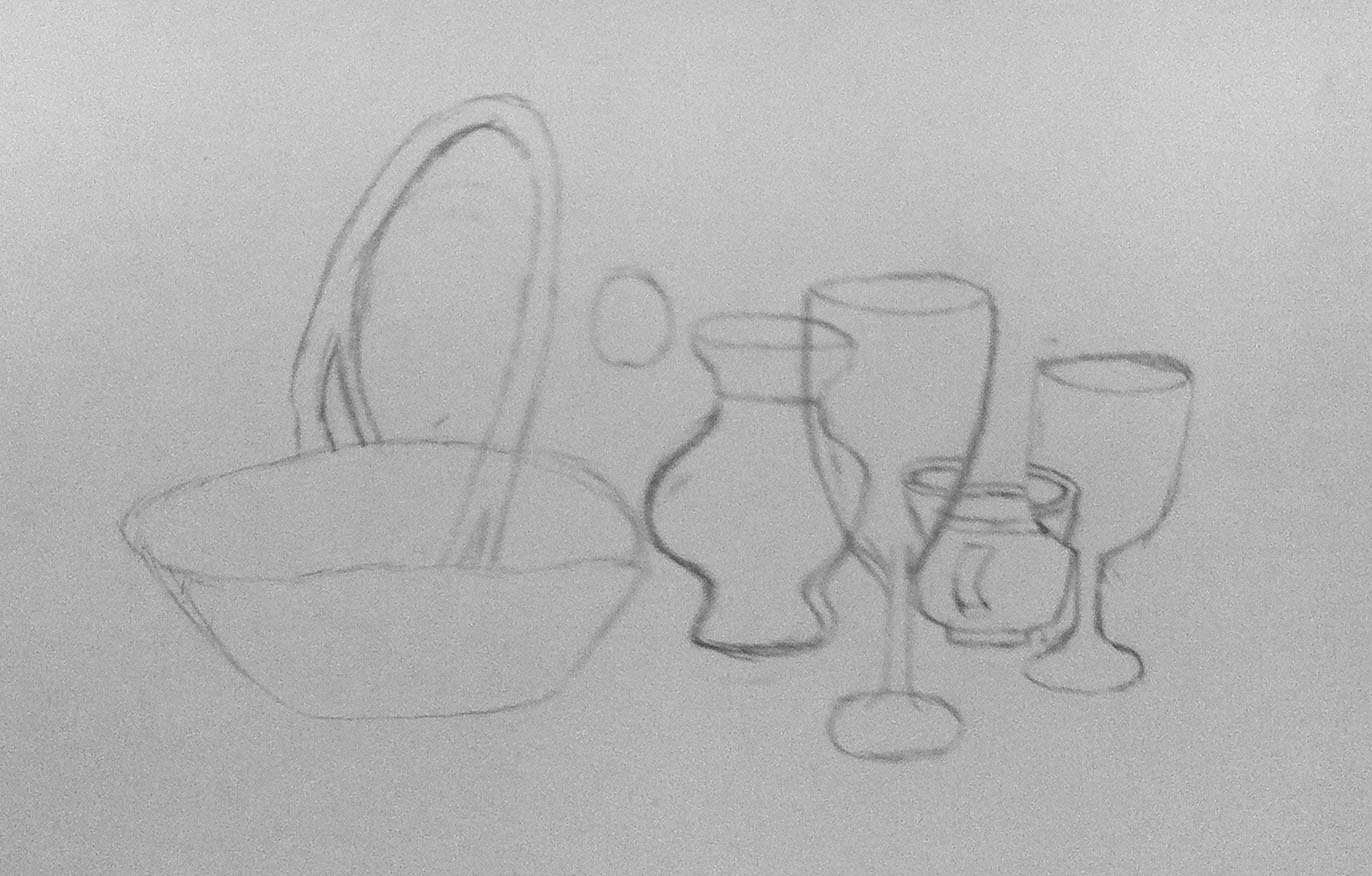
Blind Contour

Cross Contour

Blind Contour

Blind Contour 

Blind Contour and Line Variation 


Blind Contour 

Line Variation 
Blind Contour 
Cross Contour
Contour 
Oil Paint

UNDER CONSTRUCTION ...
Oil Painting
Introduction

Oil Painting Introduction
Adult: Beginner - Intermediate
[Class Dates]


Overview


This is a five-day course (3hrs/day). The primary subjects relate to oil paint and what it takes to make a painting. Working with pen and pencil, participants will develop ideas and plan a painting. Two full classes are spent making a painting of the artist’s choosing.

Objectives


Develop the tools to make an original oil painting. Get the fundamentals down and use them to draw from life and photo references.

Days


1.     Intro & Materials
2.     Viscous Mediums and Composition Pattern, Movement, and Contrast (Composition of brushstrokes)
3.     Ideas: Content/Subject
(Sources, Thumbnails, Drafts, and Sketchbooks)
4.     Prep and developing a painting
(Blocking-in and painting with Oil on Canvas)
5.     Develop and Finishing Touches
(Oil on Canvas)

Outcome


At the end of these classes, participants will have 2 oil paintings. A further understanding of the medium will have been developed through application and discussion.


Materials


Oil Paint Set, 1 Small & 1 Large Canvas. Assorted Brushes, Sealable Jars, Palette, Small Bottle of Mineral spirits, Basic 8x11 Sketchbook, 2 black pens (Jelly Roll), Pencils

1. Materials

When choosing oil paint, it is useful to understand they can vary greatly in terms of colours, brands, grades, ingredients and consistencies. The first class will largely cover health hazards and this sort of information about materials. If you want to get into it right away “The Suggested Minimum Set” (below) should be a good starting point, otherwise just bring 2 colours and a white to the first class and we can talk about what else will be useful to meet your goals and add it later.  If you have any questions feel free to email me (get contact info from Art Centre). 

Please DO NOT BUY SUPPLIES THAT ARE “FAST DRYING” or contain any turpentine or mineral spirits. The fumes from these paints are unpleasant and can cause very serious health problems.

For the purposes of this course we will try to minimize use of thinners (mineral spirits, turpentine commercial thinners) as well as carefully control where we use them. Please DO NOT BUY “ODOURLESS” SUPPLIES. It is important to know when the fumes are present.

DO NOT BUY “WATER SOLUABLE OILS”

“Suggested Minimum Set”
At least a warm and cool of each of the primary colours would be ideal:

(Small tubes are fine, but it’s better value to buy more)
Cadmium Red
Alizarin Crimson
Cadmium Yellow
Lemon Yellow
Pthalo Blue
Ultramarine Blue

*It is recommended to buy other colours too, but you can mix most (or close to them) from the list above.

(Medium tubes are fine but it’s better value to buy more)
Lamp Black
Titanium White
Zinc White

2-3 Pre-Stretched Canvases (Varied Sizes),
Assorted Brushes (eg: Sm Md Lg chisel and round shapes, with med to firm bristles)
Sealable Jars
Small Bottle of Mineral spirits (not odorless! If you’re unsure what to get, feel free to wait till second class to buy).
Palette, Palette Knife, Small Bottle of Walnut, Linseed and/or Poppy Oil

Basic 8x11 Sketchbook, 2 black pens (Jelly Roll), Pencils

oil links

https://youtu.be/DAQnar9Jf1M

https://youtu.be/TNB3XY67Q-I

Character Design


Overview

This is was originally designed as a five-day (3hrs/day) class focusing on character design. Generate a simple, repeatable character drawn from multiple angles. Starting with the idea stage, brainstorm, and iterations. Using basic shapes and forms build the character with modeling clay and draw it from different angles in different poses.  

Objectives

Learn tools to create and develop characters. Make illustrations of a character from 3 different angles.

Parts

1.     Intro, Character Definition, Ideas (Inkblot Characters, Thumbs and Fast Sketches)
2.     Practicalities and Context (Economical Drawing, Story)
3.     Form from Shapes (Model Clay, and Contours)
4.     Colouring (Choosing and Blocking in Hue, Value)
5.     Inking (Calligraphic and Enhanced Line Quality)

Outcome

At the end of this class, participants will have a pliable model, preliminary and finished drawings (which could then go on to be developed further {for example, an illustrated story, comic, cartoon, logo or animation}).


Intermediate 

(Some Drawing Skills Required)

Materials

Oil Based, Non-Drying Modeling Clay, Watercolour Set (and brushes), Black (fine tipped) Markers / Pens, Pencils, Sketchbook, Good Quality Drawing Papers x 3, Brushpen


Introduction & Types of Art


Some Types of Art / Terminology


Realism (arts)

From Wikipedia, the free encyclopedia
"Realism in aesthetics" redirects here. For other uses, see Aesthetic Realism (disambiguation).
Not to be confused with Realism (art movement).


Bonjour, Monsieur Courbet, 1854. A Realist painting by Gustave Courbet.
Realism (or naturalism) in the arts is the attempt to represent subject matter truthfully, without artificiality and avoiding artistic conventions, implausible, exotic and supernatural elements.

Realism has been prevalent in the arts at many periods, and is in large part a matter of technique and training, and the avoidance of stylization. In the visual arts, illusionistic realism is the accurate depiction of lifeforms, perspective, and the details of light and colour. Realist works of art may emphasize the ugly or sordid, such as works of social realism, regionalism, or Kitchen sink realism.
There have been various realism movements in the arts, such as the opera style of verismo, literary realism, theatrical realism and Italian neorealist cinema. The realism art movement in painting began in France in the 1850s, after the 1848 Revolution.[1] The realist painters rejected Romanticism, which had come to dominate French literature and art, with roots in the late 18th century.


Representational Art

The term 'representation' carries a range of meanings and interpretations. In literary theory, 'representation' is commonly defined in three ways.
  1. To look like or resemble
  2. To stand in for something or someone
  3. To present a second time; to re-present[2]


Typically, representational artwork aims to represent actual objects or subjects from reality. It can still be representational even if it’s stylized. Realism, Impressionism, Idealism, as long as it is representing something (usually discernibly) it can be called representational.

Pierre-Auguste Renoir. Two Sisters (on the Terrace), 1881


Abstracted or Stylized


abstraction definition:

1. An abstract or general idea or term.
2. The act of considering something as a general quality or characteristic, apart from concrete realities, specific objects, or actual instances.
3. An impractical idea; something visionary and unrealistic.
4. The act of taking away or separating; withdrawal:
The sensation of cold is due to the abstraction of heat from our bodies.

in Fine Arts.
  1. the abstract qualities or characteristics of a work of art.
  2. a work of art, especially a nonrepresentational one, stressing formal relationships.

For sake of discussion we could simplify abstract as a term to mean sort-of ‘artistically changed’. This spectrum of art can be anywhere from slightly abstracted all the way to unrecognizable subjects (not literally depicting something).


Georges Braque. Woman with Guitar, 1913

Renee Magritte. The Treachery of Images, 1928-1929
The often misunderstood type of art known as abstraction aims to take subjects from reality but present them in way that is different from the way they are viewed in our reality. This may take the form of emphasizing lines, shapes, or colors that transform the subject.
Magritte painting entitled, "The Treachery of Images", 1928-1929.  Written in French under a representational painting of a pipe, is the phrase, "This is not a pipe."  The point is that the painting is indeed not a pipe, but rather a painting of a pipe.  Artists of this time where now approaching paintings as paintings, allowing for a new form of intellectual expression.  Many people have difficultly in understanding the differences between abstract art and non-objective art.  The clear difference lies in the subject matter chosen. If the artist begins with a subject from reality, the artwork is considered to be abstract.  If the artist is creating with no reference to reality, then the work is considered to be non-objective. 


Non-Objective

Non-Objective art takes nothing from reality. It is created purely for aesthetic reasons. The intent of Non-objective art is to use the elements and principles of art in a way that results in a visually stimulating work.

Non-Representational
This, as the name suggests, is art that does not depict a discernable subject. No representation has been made. In definition, it can be somewhat interchangeable with Non-Objective.


Jackson Pollock. Number One 1948


The best way to learn about kinds of art is from history. The internet is an amazing place for this.
Here's an example of a rather comprehensive time line, from cave art to the 19th century (although a bit of a Eurocentric one):
Early Art History
I also like learning about modern art, street art and going to galleries.


Knowing What Type of Art to Use / Communicating

Some decisions will be intuitive while others may require further consideration. Either way, how and what your trying to communicate go closely together.

In 2007/08 I lived in South Korea. I didn’t speak the language and many ‘even-basic things’ were difficult to do.

One day I went to a large department store looking to find a bike lock. All the signage and service staff used a language I know nothing of. That day I happened to have a small sketchbook in my possession. I drew a simple picture of a bike lock, and showed one of the people working in the store. They immediately knew what I wanted and led me straight there. It was the first time I can remember using art to communicate in such a way, and I started bringing my sketchbook everywhere.

The kind of drawing I do to ask for a bike lock, and the kind I do to hang on the wall are usually quite different. In the case of getting an idea across, a fast simple line drawing is usually the best answer.


When drawing fast, start with the basic shapes and structure. Omit details. Fast drawing is also a good way to get gesture, movement or record something that will soon be gone or change.


As an exploration of drawing it's good to be "to the point" sometimes. Inversely so, there is value in learning to make a picture purely from your mind. It can help you shake off 'writer's block' and make divergent-thinking kind of discoveries. Instead of imagery, think of rhythm or pattern.

Here's a link to an interesting example:
Abstract Drawing